Showing posts with label Steve McQueen. Show all posts
Showing posts with label Steve McQueen. Show all posts
Sunday, June 10, 2012


Thursday, January 19, 2012
A Tribute To The Magnificent Seven (The Movie)
The music on the video is the theme of the movie. The clips in the video are from “The Magnificent Seven” (the movie)
This video was put up on You Tube by austinmillbarge22.
Sunday, December 11, 2011
Steve McQueen-Films And Awards
Films:
Girl on the Run (1953)
Somebody Up There Likes Me (1956)
Never Love a Stranger (1958)
The Blob (1958)
The Great St. Louis Bank Robbery (1959)
Never So Few (1959)
Man from the South (1960) (Alfred Hitchcock)
The Magnificent Seven (1960)
The Honeymoon Machine (1961)
Hell Is for Heroes (1962)
The War Lover (1962)
The Great Escape (1963)
Soldier in the Rain (1963)
Love with the Proper Stranger (1963)
Baby the Rain Must Fall (1965)
The Cincinnati Kid (1965)
Nevada Smith (1966)
The Sand Pebbles (1966)
Think Twentieth (1967) (short subject)
Bullitt: Steve McQueen's Commitment to Reality (1968) (short)
The Thomas Crown Affair (1968)
Bullitt (1968)
The Reivers (1969)
Le Mans (1971)
On Any Sunday (1971) (documentary)
Junior Bonner (1972)
The Getaway (1972)
The Life and Legend of Bruce Lee (1973) (documentary)
Papillon (1973)
The Towering Inferno (1974)
Dixie Dynamite (1976) (Cameo)
Bruce Lee, the Legend (1977) (documentary)
An Enemy of the People (1978) (also executive producer)
Tom Horn (1980) (also executive producer)
The Hunter (1980)
Awards:
-
Academy Awards
-
(1967) Nominated – Best Actor in a Leading Role / The Sand Pebbles
Golden Globe Awards
-
(1964) Nominated – Best Actor – Motion Picture Drama / Love with the Proper Stranger
-
(1967) Nominated – Best Actor – Motion Picture Drama / The Sand Pebbles
-
(1970) Nominated – Best Actor – Motion Picture Musical or Comedy / The Reivers
-
(1974) Nominated – Best Actor – Motion Picture Drama / Papillon
-
Steve McQueen mural by Kent Twitchell, 1971
Saturday, December 10, 2011
Steve McQueen-Legacy

McQueen still remains one of the most popular stars. His estate limits the licensing of his image to avoid the commercial saturation experienced by some other deceased celebrities. In 2007, McQueen was entered in the top 10 of highest-earning dead celebrities.
In the latter part of 1999, McQueen was inducted into the Motorcycle Hall of Fame. McQueen was credited with contributions including financing the film “On Any Sunday”, supporting a team of off-road riders, and enhancing the public image of motorcycling overall.
A film based on unfinished notes developed by McQueen before his death was announced for production by McG's production company Wonderland Sound and Vision. “Yucatan” is described as an "epic adventure heist" film, and scheduled for release in 2013. Team Downey, the production company started by Robert Downey Jr. and his wife Susan Downey, has also expressed an interest in developing “Yucatan” for the screen.
The Beech Grove Public Library, in Beech Grove, Indiana, dedicated the Steve McQueen Birthplace Collection on March 16, 2010 to commemorate the 80th anniversary of McQueen's birth.
Friday, December 9, 2011
Steve McQueen-Death
McQueen died at the age of 50 in Ciudad Juárez, Chihuahua, Mexico, following an operation to remove or reduce several metastatic tumors in his neck and abdomen on November 7, 1980.
McQueen developed a persistent cough in 1978. He gave up smoking and underwent antibiotic treatments without improvement. Shortness of breath became more pronounced in December 1979. After the filming of “The Hunter”, a biopsy revealed malignant mesothelioma. By February 1980, there was evidence of widespread metastasis. In July, McQueen traveled to Rosarito Beach for treatment. U.S. doctors advised him that they could do nothing to help him.
Controversy arose over McQueen's Mexican trip. McQueen had sought a very non-traditional treatment of coffee enemas, frequent shampoos, injection of live cells from cows and sheep, massage and laetrile, a "natural" anti-cancer drug available in Mexico.
McQueen was treated by William Donald Kelley, whose only medical license had been (until it was revoked in 1976) for orthodontics. Kelley's methods created a sensation in both the traditional and tabloid press when it became known that McQueen was a patient.
Kelley publicly announced McQueen would be completely cured and return to normal life. However, McQueen's condition worsened and "huge" tumors developed in his abdomen. In October 1980, McQueen flew to Ciudad Juárez to have the five-pound abdominal tumors removed. Despite the warnings of his U.S. doctors that the tumor was inoperable and that his heart wouldn’t withstand the surgery. McQueen checked into a Juarez clinic under the assumed name of "Sam Shepard" where doctors at the small, low-income clinic were unaware of his real identity. McQueen died of cardiac arrest one day after the operation to remove the large tumor from his neck.
Shortly before his death, McQueen was given a medical interview in which he blamed his condition on asbestos exposure. While McQueen felt that asbestos used in movie soundstage insulation and race-drivers' protective suits and helmets could have been involved. McQueen believed his illness was a direct result of massive exposure from removing asbestos lagging from pipes aboard a troop ship during his time in the Marines.
A memorial service was presided over by Leonard DeWitt of the Ventura Missionary Church. McQueen was cremated. His ashes were spread in the Pacific Ocean.
Thursday, December 8, 2011
Steve McQueen-Motor Racing
-
Porsche 917, Porsche 908 and Ferrari 512 race cars from the Le Mans film.
-
1963 Ferrari 250 Lusso Berlinetta
-
Jaguar D-Type XKSS (Right-Hand Drive)
-
Porsche 356 Speedster

McQueen was a motorcycle and racecar enthusiast. When he had the opportunity to drive in a movie, he performed many of his own stunts. The most memorable were the car chase in “Bullitt” and motorcycle chase in “The Great Escape”. McQueen did have a considerable amount of screen time riding his 650cc Triumph TR6 Trophy motorcycle. It was difficult to find riders as skilled as McQueen. Due to clever editing, McQueen is seen in a German uniform chasing himself on another bike.
Together with John Sturges, McQueen planned to make “Day of the Champion” a movie about Formula One racing. He was busy with the delayed “The Sand Pebbles”. The project was called off.
McQueen considered becoming a professional race car driver. In the 1970 12 Hours of Sebring race, Peter Revson and McQueen won with a Porsche 908/02 in the 3 litre class. They missed winning overall by 23 seconds to Mario Andretti/Ignazio Giunti/Nino Vaccarella in a 5 litre Ferrari 512S. The same Porsche 908 was entered by McQueen production company Solar Productions as a camera car for “Le Mans” in the 1970. McQueen wanted to drive a Porsche 917 with Jackie Stewart in that race, but his film backers threatened to pull their support if he did. Faced with the choice of driving for 24 hours in the race or driving the entire summer making the film, McQueen opted to do the latter. “Le Mans” is considered by some to be the most realistic representation in the history of the race.
McQueen competed in off-road motorcycle racing. His first off-road motorcycle was a Triumph 500cc that he purchased from friend and stunt man Ekins. McQueen raced in many top off-road races on the West Coast. In 1964, with Ekins on their Triumph TR6 Trophys, he represented the United States in the International Six Days Trial. It was a form of off-road motorcycling Olympics. He was inducted in the Off-road Motorsports Hall of Fame in 1978. In 1971, Solar Productions funded the now-classic motorcycle documentary “On Any Sunday”. McQueen is featured along with racing legends Mert Lawwill and Malcolm Smith. Also in 1971, McQueen was on the cover of Sports Illustrated magazine riding a Husqvarna dirt bike.
McQueen collected classic motorcycles. By the time of his death, his collection included over 100 and was valued in the millions of dollars.
In a segment filmed for “The Ed Sullivan Show”, McQueen drove Sullivan around a desert area in a dune buggy at high speed. All the breathless Sullivan could say was, "That was a helluva ride!"
McQueen owned several exotic sports cars, including:
McQueen was never able to own the legendary Ford Mustang GT 390 that he drove in “Bullitt”. It featured a highly modified drivetrain that suited McQueen's driving style.
Wednesday, December 7, 2011
Steve McQueen-Acting Career
-
Movie Legend Steve McQueen

McQueen began studying acting at Sanford Meisner's Neighborhood Playhouse in 1952, with financial assistance provided by the G.I. Bill. He also started to earn money by competing in weekend motorcycle races at Long Island City Raceway which helped him purchased his first of many motorcycles, a used Harley Davidson. He became an excellent racer, and would come home each weekend with about $100 in winnings.
At first McQueen appeared several minor roles in “Peg o' My Heart”, “The Member of the Wedding”, and “Two Fingers of Pride”. McQueen landed his first film role in “Somebody Up There Likes Me”, also starring Paul Newman. He made his Broadway debut in 1955 in the play “A Hatful of Rain'”. McQueen appeared in a two-part television presentation entitled “The Defenders”. Hollywood manager Hilly Elkins (who managed McQueen's first wife, Neile) took note of him and decided that B-movies would be a good place for the young actor to make his mark. McQueen was hired to appear in the films “Never Love a Stranger”, “The Blob”, and “The Great St. Louis Bank Robbery”.
In late 1955, McQueen left New York, heading for California. He moved into a house on Vestal Avenue in the Echo Park area and began seeking acting jobs in Hollywood.
McQueen's first breakout role was on TV. Elkins successfully lobbied Vincent M. Fennelly, producer of the Western series “Trackdown”, to have McQueen read for the part of Josh Randall in an episode for “Trackdown”. McQueen appeared as Randall in the episode. He worked opposite series lead Robert Culp, an old New York motorcycle racing buddy. After McQueen filmed the pilot episode, the pilot was approved for a series titled “Wanted: Dead or Alive” on CBS in September 1958.
In the interviews included in the DVD release of "Wanted: Dead Or Alive", Robert Culp takes credit for first bringing McQueen to Hollywood and landing him the part of Randall. Culp even claims to have taught McQueen the "art of the fast-draw". Culp added that, on the second day of filming, McQueen beat him. McQueen became a household name as a result of this series. Randall's special holster held a sawed-off .44-40 Winchester rifle nicknamed the "Mare's Leg". Coupled with the generally negative image of the bounty hunter that added to the anti-hero image infused with a mixture of mystery and detachment that made this show stand out from the typical TV Western. From 1958 until early 1961, kept McQueen steadily employed.
At 29, McQueen got a significant break when Frank Sinatra removed Sammy Davis, Jr. from the film “Never So Few” after Davis supposedly made some mildly negative remarks about Sinatra in a radio interview. Davis' role went to McQueen. Sinatra saw something special in McQueen and ensured that the young actor got plenty of good close-ups in a role. McQueen earned favorable reviews.
Afterwards, John Sturges, “Never So Few”, the film's director, cast McQueen in his next movie, “The Magnificent Seven” with Yul Brynner, Robert Vaughn, Charles Bronson, and James Coburn. The movie was McQueen's first major hit and led to his withdrawal from “Wanted: Dead or Alive”. McQueen's focused portrayal of the taciturn second lead catapulted his career. His added touches in each scene, such as shaking each shotgun round before loading it and wiping his hat rim, annoyed co-star Brynner, who protested that McQueen was trying to steal the scene. Brynner refused to draw his gun in the same scene with Steve, not wanting to have his character outdrawn.
McQueen played the lead in the next big Sturges film, “The Great Escape”, which gave Hollywood's depiction of the otherwise true story of an historical mass escape from a World War II POW camp, Stalag Luft III. Insurance concerns prevented McQueen from performing the film's widely noted motorcycle leap, which was instead done by his friend, Bud Ekins. When Johnny Carson later tried to congratulate McQueen for the jump during a broadcast of “The Tonight Show”, McQueen said, "It wasn't me. That was Bud Ekins." This film established McQueen's box-office clout and his status as a superstar.
In 1963, McQueen starred with Natalie Wood in “Love with the Proper Stranger”. He later appeared in a prequel as the “Nevada Smith”. McQueen earned his only Academy Award nomination in 1966 for his role as an engine room sailor in “The Sand Pebbles”, in which he starred opposite Richard Attenborough and Candice Bergen.
McQueen followed his Oscar nomination with 1968's “Bullitt”, one of his most famous films, co-starring Jacqueline Bisset and Robert Vaughn. It featured an unprecedented auto chase through San Francisco. Although McQueen did do the driving that appeared in the close up, it was only about 10% of what is seen in the film. The rest of the driving by the McQueen character was done by famed stunt drivers Bud Ekins and Loren James.
McQueen then went for a change of image, playing a debonair role as a wealthy executive in “The Thomas Crown Affair” with Faye Dunaway in 1968. McQueen made the Southern period piece “The Reivers” in 1969, followed by the 1971 auto-racing drama “Le Mans”.
Then came The Getaway during which McQueen met future wife Ali MacGraw. He worked for director Sam Peckinpah again with the leading role in “Junior Bonner” in 1972. It was a story of an aging rodeo rider. McQueen followed this with a physically demanding role as a Devils Island prisoner “Papillon”. He co-stared Dustin Hoffman as his character's tragic sidekick.
After 1974's “The Towering Inferno”, McQueen co-stared with his long-time personal friend Paul Newman and reuniting him with Dunaway. The movie became a tremendous box-office success. Afterwards, McQueen disappeared from Hollywood, preferring to focus on motorcycle racing and traveling around the country in a motorhome and on one of his vintage Indian motorcycles. He did not return to acting until 1978 in the movie, “An Enemy of the People”. The film was shown briefly in theaters and was never released on home video.
His last films were both loosely based on true stories: “Tom Horn”. It was a Western adventure about a former Army scout turned professional gunman.
“The Hunter”, an urban action movie about a modern-day bounty hunter, both released in 1980.
Related Articles:
Monday, December 5, 2011
Steve McQueen-Personal Life

McQueen exercised two-hour, involving weightlifting and at one point running five miles, seven days a week. He learned the martial art Tang Soo Do from ninth degree black belt Pat E. Johnson.
McQueen was arrested in Anchorage for drunk driving in 1972. He was also known for his prolific drug use. William Claxton claimed McQueen smoked marijuana almost every day. Others said he used a tremendous amount of cocaine in the early 1970s. Like many actors of his era, McQueen was a heavy cigarette smoker.
After Charles Manson incited the murder of five people, including McQueen's friends, Sharon Tate and Jay Sebring, at Tate's home on August 9, 1969, it was rumored that McQueen was another potential target of the killers. According to his first wife, McQueen began carrying a handgun at all times in public, even at Sebring's funeral.
McQueen had an unusual reputation for demanding free items in bulk from studios when agreeing to do a film, such as electric razors, jeans, and several other products. It was later found out that he requested these things because he was donating them to the Boy's Republic Reformatory School for displaced youth. McQueen made occasional visits to the school to spend time with the students, often to play pool and to speak with them about his experiences.
After discovering a mutual interest in racing, McQueen and his Great Escape co-star James Garner became good friends. Garner lived directly down the hill from McQueen . McQueen recalled, "I could see that Jim was very neat around his place. Flowers trimmed, no papers in the yard ... grass always cut. So, just to piss him off, I'd start lobbing empty beer cans down the hill into his driveway. He'd have his drive all spic 'n' span when he left the house, then get home to find all these empty cans. Took him a long time to figure out it was me.”
McQueen was conservative in his political views and often backed the Republican Party. He did, however, campaign for Democrat Lyndon Johnson in 1964. He supported the Vietnam War. He was one of the few Hollywood stars ,who refused numerous requests to back Presidential hopeful Robert Kennedy, in 1968. He turned down the chance to participate in the 1963 March on Washington. When McQueen heard a rumor that he had been added to Nixon's Enemies List, he responded by immediately flying a giant American flag outside his house. Reportedly, his wife Ali McGraw responded to the whole affair by saying, "But you're the most patriotic person I know."
McQueen commanded such respect in the United Kingdom that when visiting Chelsea Football Club's Stamford Bridge Stadium to watch a match, he was personally introduced to the players in the dressing room during the half-time break.
Barbara Minty McQueen in her book, ‘Steve McQueen: The Last Mile’, writes of McQueen becoming an Evangelical Christian toward the end of his life. This was due in part to the influences of his flying instructor, Sammy Mason, and his son Pete, and Barbara. McQueen attended his local church, Ventura Missionary Church, and was visited by evangelist Billy Graham shortly before his death.
McQueen was married three times: to Neile Adams, Ali MacGraw, and Barbara Minty. He had two children with Neile Adams (Terry and Chad). MacGraw stated in her autobiography, Moving Pictures, that she had a miscarriage during her marriage to McQueen.
Sunday, December 4, 2011
Steve McQueen-Military Service

In 1947, McQueen joined the United States Marine Corps. He was quickly promoted to Private First Class. He was assigned to an armored unit. He reverted to his prior rebelliousness ways. As a result McQueen was demoted to private seven times. He went UA (unauthorized absence) by failing to return after a weekend pass had expired. He stayed away with a girlfriend for two weeks, until the shore patrol caught him. He resisted arrest as a result spent 41 days in the brig.
After this, McQueen resolved to focus his energies on self-improvement, embracing the Marines' discipline. He saved the lives of five other Marines during an Arctic exercise. He pulled them from a tank before it broke through ice into the sea. He was also assigned to an honor guard responsible for guarding the U.S. President Harry Truman's yacht. McQueen served until 1950 when he was honorably discharged.
Saturday, December 3, 2011
Steve McQueen-Early Life

Steve McQueen was born Terrence Steven McQueen in Beech Grove, Indiana. His father, Terrence William McQueen abandoned McQueen and his mother when McQueen was six months old. His mother, Julian was a young, rebellious alcoholic.
Unable to cope with bringing up a small child, she left him with her parents (Victor and Lillian) in Slater, Missouri, in 1933. As the Great Depression set in, McQueen and his grandparents moved in with Lillian's brother Claude to the latter's farm in Slater.
McQueen had good memories of the time spent on his great-uncle Claude's farm. In recalling Claude, McQueen stated "He was a very good man, very strong, very fair. I learned a lot from him.” On McQueen's fourth birthday, Claude gave him a red tricycle, which McQueen later started his interest in racing. At age 8, he was taken back by his mother and lived with her and her new husband in Indianapolis. McQueen retained a special memory of leaving the farm: "The day I left the farm Uncle Claude gave me a personal going-away present; a gold pocket watch, with an inscription inside the case." The inscription read: "To Steve -- who has been a son to me."
McQueen, who was dyslexic and partially deaf as a result of a childhood ear infection. He did not adjust well to his new life. Within a couple of years, he was running with a street gang and committing acts of petty crime. Unable to control McQueen, his mother sent him back to Slater again. When McQueen was 12, Julian wrote to Claude asking once again that McQueen be returned to her, this time in Los Angeles, California. Julian, whose second marriage had ended in divorce, had married a third time.
This began an unsettled period in McQueen's life. By McQueen's own account, he and his new stepfather "locked horns immediately." McQueen recounted him as "a prime son of a bitch" who was not averse to using his fists on both McQueen and his mother. McQueen began to rebel once again, he was sent back to live with Claude a final time. At age 14, McQueen left Claude's farm without saying goodbye and joined a circus for a short time. After which he slowly drifted back to his mother and stepfather in Los Angeles. He resumed his life as a gang member and petty criminal. On one occasion, McQueen was caught stealing hubcaps by police, who handed him over to his stepfather. The latter proceeded to beat McQueen severely, and ended the fight by throwing McQueen down a flight of stairs. McQueen looked up at his stepfather and said, "You lay your stinkin' hands on me again and I swear, I'll kill ya."
After that incident, McQueen's stepfather convinced Julian to sign a court order stating that McQueen was incorrigible and remanding him to the California Junior Boys Republic in Chino, California. McQueen slowly began to change and mature. He was not popular with the other boys at first: "Say the boys had a chance once a month to load into a bus and go into town to see a movie. They lost out because one guy in the bungalow didn't get his work done right. Well, you can pretty well guess they're going to have something to say about that. I paid his dues with the other fellows quite a few times. I got my lumps, no doubt about it. The other guys in the bungalow had ways of paying you back for interfering with their well-being."
McQueen decided to give Boys Republic a fair shake. He became a role model for the other boys when he was elected to the Boys Council. Boys Council was a group who made the rules and regulations governing the boys' lives. He eventually left Boys Republic at 16. He later became famous, he regularly returned to talk to the boys there. He also personally responded to every letter he received from the boys there, and retained an association.
After McQueen left Chino, he returned to Julian, now living in Greenwich Village, but almost immediately left again. He met two sailors there from the Merchant Marine and volunteered to serve on a ship bound for the Dominican Republic. When he got there, McQueen abandoned his new post. He eventually made his way to Texas, and drifted from job to job.
Friday, December 2, 2011
Tribute To Steve McQueen
-
Steve McQueen Official Website
-
Steve McQueen - Wikipedia, the free encyclopedia
-
The First Steve McQueen Site-Biography
-
Steve McQueen Shares His Thoughts On Hollywood Directors
-
Steve McQueen- Biography from Answers.com
*****************************

humanbeinz put this video up on You Tube.
*****************************
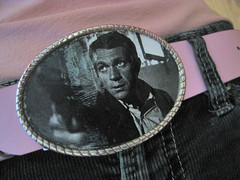
Born:
Terrence Steven McQueen
March 24,1930
Beech Grove, Indiana
Died:
November 7, 1980
Ciudad, Chihuahua, Mexico
*****************************
Few Articles On Steve McQueen:
*****************************
Subscribe to:
Posts (Atom)