Showing posts with label Rita Hayworth. Show all posts
Showing posts with label Rita Hayworth. Show all posts
Sunday, September 9, 2012


Thursday, August 2, 2012
Rita Hayworth-Films
As Rita Cansino
- La Fiesta (Short subject, 1926)
- Cruz Diablo aka The Devil's Cross (Unaccredited, 1934)
- In Caliente (1935)
- Under the Pampas Moon (1935)
- Charlie Chan in Egypt (1935)
- Dante's Inferno (1935)
- Paddy O'Day (1935)
- Human Cargo (1936)
- Meet Nero Wolfe (1936)
- Rebellion (1936)
- The Dancing Pirate (1936)
- Old Louisiana (1937)
- Hit the Saddle (1937)
- Trouble in Texas (1937)
As Rita Hayworth
- Criminals of the Air (1937)
- Girls Can Play (1937)
- The Game That Kills (1937)
- Paid to Dance (1937)
- The Shadow (1937)
- Who Killed Gail Preston? (1938)
- Special Inspector (1938)
- There's Always a Woman (1938)
- Convicted (1938)
- Juvenile Court (1938)
- The Renegade Ranger (1938)
- Homicide Bureau (1939)
- The Lone Wolf Spy Hunt (1939)
- Only Angels Have Wings (1939)
- Music in My Heart (1940)
- Blondie on a Budget (1940)
- Susan and God (1940)
- The Lady in Question (1940)
- Angels Over Broadway (1940)
- The Strawberry Blonde (1941)
- Affectionately Yours (1941)
- Blood and Sand (1941)
- You'll Never Get Rich (1941)
- My Gal Sal (1942)
- Tales of Manhattan (1942)
- You Were Never Lovelier (1942)
- Show Business at War (1943) (short subject)
- Cover Girl (1944)
- Tonight and Every Night (1945)
- Gilda (1946)
- Down to Earth (1947)
- The Lady from Shanghai (1947)
- The Loves of Carmen (1948)
- Champagne Safari (1952)
- Affair in Trinidad (1952)
- Salome (1953)
- Miss Sadie Thompson (1953)
- Fire Down Below (1957)
- Pal Joey (1957)
- Separate Tables (1958)
- They Came to Cordura (1959)
- The Story on Page One (1959)
- The Happy Thieves (1962)
- Circus World (1964)
- The Money Trap (1965)
- The Poppy Is Also a Flower (1966)
- L'Avventuriero (1967)
- I Bastardi (1968)
- The Naked Zoo (1971)
- Road to Salina (1971)
- The Wrath of God (1972)
Wednesday, August 1, 2012
Rita Hayworth-Awards And Legacy
Awards
- 1964: Golden Globe nomination for Best Actress — Motion Picture Drama in Circus World (1964)
- 1977: National Screen Heritage Award.
- Hayworth is included as one of the American Film Institute's Greatest Stars of All Time.
Legacy
- A fund raiser for the Alzheimer's Association is named in her honor by her daughter, Yasmin Aga Khan, who has been the hostess for these events and a major sponsor of Alzheimer's Disease charities and awareness programs.
- The film I Remember Better When I Paint (2009) describes how Hayworth took up painting while struggling with Alzheimer's and produced art.
Tuesday, July 31, 2012
Rita Hayworth-Death
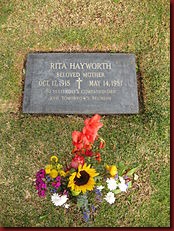
Rita Hayworth lapsed into a semicoma in February 1987. She died at age 68 from Alzheimer's disease a few months later on May 14, 1987. A funeral service was held on May 19, 1987, at the Church of the Good Shepherd in Beverly Hills. Pallbearers included actors Ricardo Montalbán, Glenn Ford, Don Ameche and the choreographer Hermes Pan. She was interred in Holy Cross Cemetery, Culver City. Her headstone includes the inscription: "To yesterday's companionship and tomorrow's reunion."
"Rita Hayworth was one of our country's most beloved stars", said President Ronald Reagan, who had been an actor at the same time as Hayworth.
"Glamorous and talented, she gave us many wonderful moments on stage and screen and delighted audiences from the time she was a young girl. In her later years, Rita became known for her struggle with Alzheimer's disease. Her courage and candor, and that of her family, were a great public service in bringing worldwide attention to a disease which we all hope will soon be cured. Nancy and I are saddened by Rita's death. She was a friend who we will miss. We extend our deep sympathy to her family."
Monday, July 30, 2012
Rita Hayworth-Health

Hayworth struggled with alcohol throughout her life. Her daughter Yasmin Aga Khan said,
"I remember as a child that she had a drinking problem. She had difficulty coping with the ups and downs of the business ... As a child, I thought, 'She has a drinking problem and she's an alcoholic.' That was very clear and I thought, 'Well, there's not much I can do. I can just, sort of, stand by and watch.' It's very difficult, seeing your mother, going through her emotional problems and drinking and then behaving in that manner ... Her condition became quite bad. It worsened and she did have an alcoholic breakdown and landed in the hospital."
In 1972, Hayworth was 54 years old and wanted to retire from acting, but she needed money so signed up for “The Wrath of God”. The experience exposed her poor health and worsening mental state. As she could not remember lines, they filmed her scenes one line at a time.
The following year Hayworth agreed to do one more movie, “Tales That Witness Madness”. Due to worse health, she abandoned the movie set, and returned to the United States. She never returned to acting.
In March 1974, both her brothers died within a week of each other, which caused her great sadness and led to heavy drinking. In 1976 at London's Heathrow Airport, Hayworth was removed from a TWA flight after having an angry outburst while traveling with her agent. "Miss Hayworth had been drinking when she boarded the plane," revealed a TWA flight attendant, "and had several free drinks during the flight." The event attracted much negative publicity; a disturbing photograph was published in newspapers.
Hayworth's alcoholism hid symptoms of what was eventually understood to be Alzheimer's disease. "For several years in the 1970s, she had been misdiagnosed as an alcoholic."
"It was the outbursts," said her daughter, "She'd fly into a rage. I can't tell you. I thought it was alcoholism-alcoholic dementia. We all thought that. The papers picked that up, of course. You can't imagine the relief just in getting a diagnosis. We had a name at last, Alzheimer's! Of course, that didn't really come until the last seven or eight years. She wasn't diagnosed as having Alzheimer's until 1980. There were two decades of hell before that."
In July 1981, Hayworth's health had deteriorated to the point where a judge in Los Angeles Superior Court ruled that she should be placed under the care of her daughter, Princess Yasmin Khan of New York City. Hayworth lived in an apartment at The San Remo on Central Park West next to her daughter, who arranged for care for her mother through her final years.
Sunday, July 29, 2012
Rita Hayworth-Personal Life

Hayworth was married and divorced five times. She said, "Basically, I am a good, gentle person, but I am attracted to mean personalities."
- Edward Charles Judson (1937–1942): When Hayworth was 18, she married Edward Judson in 1937, an oilman turned promoter who was more than twice her age. They eloped in Las Vegas. He had played a major role in launching her acting career. A shrewd businessman, he was domineering and became her manager for months before he proposed. "He helped me with my career," Hayworth conceded after they divorced, "and helped himself to my money." She alleged Judson compelled her to transfer considerable property to him and promise to pay him $12,000 under threats that he would do her "great bodily harm." She filed for divorce from him on February 24, 1942, with the complaint of cruelty. She noted to the press that his work took him to Oklahoma and Texas, while she lived and worked in Hollywood. Judson was as old as her father, who was enraged by the marriage, which caused a rift between Hayworth and her parents until the divorce. Judson had failed to tell Hayworth before they married that he had previously been twice married. When she left him, she literally had no money. She asked her friend, Hermes Pan, if she could eat at his home.
- Orson Welles (1943–1948): Hayworth married Orson Welles on September 7, 1943. None of her colleagues knew about the planned marriage (before a judge) until she announced it the day before they got married. For the civil ceremony, she wore a beige suit, ruffled white blouse, and a veil. A few hours after they got married, they returned to work at the studio. They had a daughter, Rebecca, born December 17, 1944, died June 1, 2004, aged 60. They struggled in their marriage. Hayworth said that Welles did not want to be tied down:
During the entire period of our marriage he showed no interest in establishing a home. When I suggested purchasing a home, he told me he didn't want the responsibility. Mr. Welles told me he never should have married in the first place; that it interfered with his freedom in his way of life.
- Prince Aly Khan (1949–1953): In 1948 she left her film career to marry Prince Aly Khan, a son of Sultan Mohammed Shah, Aga Khan III, the leader of the Ismaili sect of Shia Islam. They were married on May 27, 1949. Her bridal trousseau was Dior's New Look.
Aly Khan and his family were heavily involved in horse racing, owning and racing horses. Hayworth had no interest in the sport but became a member of the Del Mar Thoroughbred Club. Her filly Double Rose won several races in France and notably finished second in the 1949 Prix de l'Arc de Triomphe.
In 1951, while still married to Hayworth, Khan was spotted dancing with the actress Joan Fontaine in the nightclub where he and his wife had met. Hayworth threatened to divorce him in Reno, Nevada. In early May she moved to Nevada to establish legal residence to qualify for a divorce. She stayed at Lake Tahoe with their daughter, saying there was a threat that the child would be kidnapped. Hayworth filed for divorce from Khan on September 2, 1951, on the grounds of "extreme cruelty, entirely mental in nature."
Hayworth once said she might convert to Islam but did not. During the custody fight over their daughter Princess Yasmin Aga Khan December 26, 1949 (age 62), the Prince said he wanted her raised as a Muslim; Hayworth (who had been raised a Roman Catholic) wanted the child to be a Christian.
Hayworth rejected his offer of $1,000,000 if she would rear Yasmin as a Muslim from age seven and allow her to go to Europe to visit with him for two or three months each year.
"Nothing will make me give up Yasmin's chance to live here in America among our precious freedoms and habits," declared Hayworth. "While I respect the Muslim faith and all other faiths it is my earnest wish that my daughter be raised as a normal, healthy American girl in the Christian faith. There isn't any amount of money in the entire world for which it is worth sacrificing this child's privilege of living as a normal Christian girl here in the United States. There just isn't anything else in the world that can compare with her sacred chance to do that. And I'm going to give it to Yasmin regardless of what it costs."
- Dick Haymes (1953–1955): When Hayworth and Haymes first met, he was still married and his singing career was waning. When she showed up at the clubs, he got a larger audience. Haymes was desperate for money, as two of his former wives were taking legal action against him for unpaid child support. His financial problems were so bad he could not return to California without being arrested. On July 7, 1954, his ex-wife Nora Haymes got a bench warrant for his arrest, because he owed her $3,800 in alimony. Less than a week prior, his other ex-wife, Joanne Dru, also got a bench warrant because she said he owed $4,800 in support payments for their three children. Hayworth ended up paying most of Haymes's debts.
Haymes was born in Argentina, and did not have solid proof of American citizenship. Not long after he met Hayworth, US officials initiated proceedings to have him deported to Argentina for being an illegal alien. He hoped Hayworth could influence the government and keep him in the United States. When she assumed responsibility for his citizenship, a bond was formed that led to marriage. The two were married on September 24, 1953 at the Sands Hotel, Las Vegas, and their wedding procession went through the casino.
From the start of their marriage, Haymes was deeply indebted to the Internal Revenue Service (IRS). When Hayworth took time off from attending his comeback performances in Philadelphia, the audiences sharply declined. Haymes's $5000 weekly salary was attached by the IRS to pay a $100,000 bill, and he was unable to pay his pianist. Haymes' ex-wives demanded money while Hayworth publicly bemoaned her own lack of alimony from Aly Khan. At one point, the couple was effectively imprisoned in a hotel room for 24 hours in Manhattan at the Hotel Madison as sheriff's deputies waited outside threatening to arrest Haymes for outstanding debts. At the same time, Hayworth was fighting a severe custody battle with Khan, during which she reported death threats against their children. While living in New York, Hayworth sent the children to live with their nanny in Westchester County. They were found and photographed by a reporter from Confidential magazine.
After a tumultuous two years together, Haymes struck Hayworth in the face in 1955 in public at the Coconut Grove nightclub in Los Angeles. Hayworth packed her bags, walked out, and never returned. The assault and crisis shook her, and her doctor ordered her to remain in bed for several days.
Hayworth was short of money after her marriage to Haymes. She had failed to gain child support from Aly Khan. She sued Orson Welles for back payment of child support which she claimed had never been paid. This effort was unsuccessful and added to her stress.
- James Hill (1958–1961): Hayworth began a relationship with film producer James Hill, whom she went on to marry on February 2, 1958. He put her in one of her last major films, Separate Tables. On September 1, 1961, Hayworth filed for divorce, alleging extreme mental cruelty. He later wrote Rita Hayworth: A Memoir, in which he suggested their marriage collapsed because he wanted Hayworth to continue making movies, while she wanted them both to retire from Hollywood.
In his book, In the Arena, Charlton Heston writes about Hayworth's brief marriage to Hill. One night Heston and his wife Lydia joined the couple for dinner at a restaurant in Spain, with the director George Marshall and the actor Rex Harrison, Hayworth's co-star in “The Happy Thieves”. Heston wrote that the occasion "turned into the single most embarrassing evening of my life", describing how Hill heaped "obscene abuse" on Hayworth until she was "reduced to a helpless flood of tears, her face buried in her hands". Heston writes how the others sat stunned, witnesses to a "marital massacre" and, though he was "strongly tempted to slug him" (Hill), Heston left with his wife Lydia after she stood up, almost in tears. Heston wrote, "I'm ashamed of walking away from Miss Hayworth's humiliation. I never saw her again."
Saturday, July 28, 2012
Rita Hayworth-Later Career

After the collapse of her marriage to Aly Khan in 1951, Hayworth returned to the United States with great fanfare. She starred in a string of hit films: “Affair in Trinidad” , “Salome”, and “Miss Sadie Thompson. Her performance in the latter film won critical acclaim.
She was off the big screen for another four years, due mainly to a tumultuous marriage to the singer Dick Haymes. After making “Fire Down Below” and her last musical ‘Pal Joey” Hayworth finally left Columbia.
She received good reviews for her acting in “Separate Tables”, and ‘The Story on Page One”. She continued working throughout the 1960s. In 1962, her planned Broadway debut in “Step on a Crack” was cancelled for undisclosed health reasons. She continued to act in films until the early 1970s. She made a well-publicized 1971 television appearance on “The Carol Burnett Show”. Her last film was “The Wrath of God”.
Friday, July 27, 2012
Rita Hayworth-Film Career

During her time at Fox, Hayworth appeared in five non-notable roles pictures. By the end of her six-month contract, Fox had merged into 20th Century Fox, with Darryl F. Zanuck serving as the executive producer. Hayworth was dismissed, her contract wasn’t renewed.
Feeling that Hayworth had screen potential, the salesman and promoter Edward C. Judson, whom she would marry in 1936, got her the lead roles in several independent films and arranged a screen test with Columbia Pictures. The studio head Harry Cohn signed Hayworth to a long-term contract, and cast her in small roles in Columbia features.
Often cast as the exotic foreigner, Hayworth appeared in several roles in 1935: in ‘Dante's Inferno”, and “Paddy O'Day”. She was an Argentinean in “Under the Pampas Moon” and an Egyptian beauty in “Charlie Chan in Egypt”. In 1936 she took her first starring role as a "Latin type" in “Human Cargo”.
Cohn argued that Cansino's image was too Mediterranean, which reduced her opportunities to being cast in "exotic" roles, more limited in number. With Cohn and Judson's encouragement, Hayworth changed her hair color to dark red and her name to Rita Hayworth. She had electrolysis to raise her hairline and broaden the appearance of her forehead. By using her mother's maiden name, she led people to see her British-American ancestry and became a classic "American" pin-up.
In 1937, Hayworth appeared in five minor Columbia pictures and three minor independent movies. The following year, she appeared in five Columbia B films. In 1939, Cohn pressured director Howard Hawks to use Hayworth for a small but important role as a man-trap in the aviation drama “Only Angels Have Wings”. With this film's box-office success, fan mail for Hayworth began pouring into Columbia's publicity department. Cohn began to see Hayworth as his first and official new star. The studio never officially had stars under contract, except for Jean Arthur, who was trying to break with it.
Cohn began to build Hayworth up in 1940, in features such as “Music in My Heart”, “The Lady in Question”, and “Angels Over Broadway”. That year she was first featured in a Life magazine photo. He loaned Hayworth to Metro-Goldwyn-Mayer to appear in “Susan and God”. While on loan to Warner Brothers, Hayworth appeared as the second female lead in “The Strawberry Blonde”, opposite James Cagney and Olivia de Havilland. As the film was a big box-office success, Hayworth's popularity rose; she immediately became one of Hollywood's hottest properties. So impressed was Warner Brothers that they tried to buy Hayworth's contract from Columbia, but Cohn refused to release her.
Her success led to a supporting role in “Blood and Sand”, with Fox. The studio that had dropped her six years before. In one of her most notable screen roles, Hayworth played Doña Sol des Muire, the first of many screen sirens. This was another box-office hit.
She returned in triumph to Columbia Pictures and was cast in the musical “You'll Never Get Rich” opposite Fred Astaire. It was in one of the highest-budgeted films Columbia had ever made. So successful was the picture that the following year, the studio produced and released another Astaire-Hayworth picture, “You Were Never Lovelier”. In 1942, Hayworth also appeared in two other pictures, “Tales of Manhattan” and “My Gal Sal”.
During this period, Hayworth was featured in an August 1941 Life Magazine photo, in which she lounged seductively in a black-lace negligee. When the U.S. joined World War II in December 1941, the photo made Hayworth one of the top two "pin-up girls" of the war years; the other was the blonde Betty Grable. In 2002, the satin nightgown Hayworth wore for the photo sold for $26,888.
Thursday, July 26, 2012
Rita Hayworth-Early Life

Hayworth was born in Brooklyn, New York in 1918 as Margarita Carmen Cansino, She was the oldest child of two dancers, Eduardo Cansino, Sr., and Volga Hayworth. The Catholic couple had married in 1917. They also had two sons: Eduardo, Jr. and Vernon.
Margarita's father wanted her to become a professional dancer. Her mother hoped she would become an actress. Her paternal grandfather Antonio Cansino was renowned as a Spanish classical dancer. Antonio Cansino popularized the bolero and his dancing school in Madrid was world famous. Rita later recalled,
From the time I was three and a half ... as soon as I could stand on my own feet, I was given dance lessons." I didn't like it very much ... but I didn't have the courage to tell my father, so I began taking the lessons. Rehearse, rehearse, rehearse, that was my girlhood.
Hayworth attended dance classes every day for a few years in a Carnegie Hall complex, where she was taught by her uncle Angel Cansino. She performed publicly from the age of six. In 1926, the eight year old Hayworth was featured in “La Fiesta”, a short film for Warner Bros.
In 1927, her father took the family to Hollywood. He believed that dancing could be featured in the movies and that his family could be part of it. He established his own dance studio, where he taught such Hollywood luminaries as James Cagney and Jean Harlow. During the Great Depression, he lost all his investments, as musicals were no longer in vogue and commercial interest in his dancing classes waned. He partnered with his daughter to form "The Dancing Cansinos". Since under California law, Margarita was too young to work in nightclubs and bars, her father took her with him to work across the border in Tijuana, Mexico. In the early 1930s, it was a popular tourist spot for people from Los Angeles. Due to her working, Hayworth never graduated from high school; she completed ninth grade at Hamilton High in Los Angeles.
At the age of 16, Hayworth took a bit part in the film “Cruz Diablo”. It led to another in “In Caliente” with the Mexican actress Dolores del Río. Hayworth danced with her father in such nightspots as the Foreign and the Caliente clubs. Winfield Sheehan, the head of the Fox Film Corporation, saw her dancing at the Caliente Club and quickly arranged for Hayworth to do a screen test a week later. Impressed by her screen persona, Sheehan signed her for a short-term six-month contract at Fox, under the name Rita Cansino, the first of name changes for her film career.
Wednesday, May 2, 2012
Monday, April 16, 2012
Tuesday, April 3, 2012
Wednesday, March 28, 2012
Sunday, March 25, 2012
Monday, February 27, 2012
Sunday, February 26, 2012
Subscribe to:
Posts (Atom)